
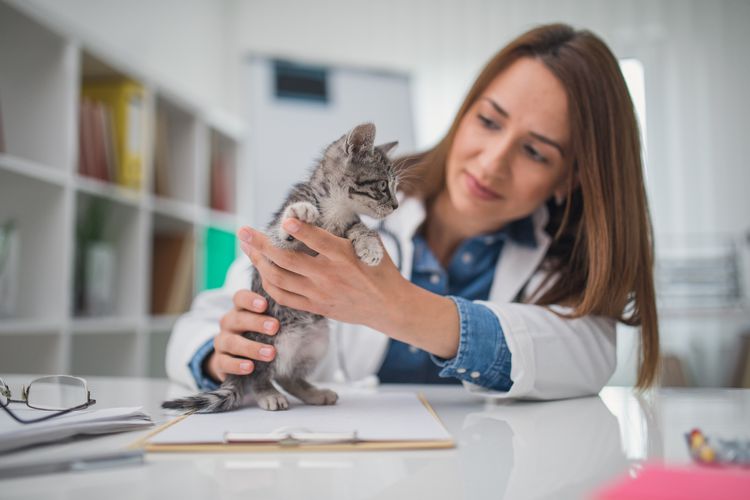
When bringing home a newly adopted kitten, it is imperative that you get it checked out by a veterinarian as soon as possible. This is not only for your kitten's own health, but to also ensure that it doesn't share any serious communicable diseases. Ideally, your kitten would be examined prior to even bringing it home with you, but you should try to get it seen by a vet within 48 hours if the kitten appears to be healthy. If the kitten is showing any symptoms of an illness, such as watery eyes, sneezing, difficulty breathing, or failure to eat, it should be seen immediately. Regardless of whether or not you think your kitten is healthy though, you should keep your kitten away from other cats until a veterinarian gives your kitten the go-ahead for socializing.
What Does a Physical Exam Consist Of?
Just like an adult cat receives, your veterinarian will perform a thorough hands-on physical examination of your kitten in order to find physical abnormalities. This examination includes:
- Checking inside your kitten's mouth: Baby teeth, the tongue, and the roof of the mouth will especially be examined.
- Taking your kitten's temperature: A normal rectal temperature of a cat is about 99 F to 102 F. If your kitten's temperature is too high or too low, it may be an indication of a problem.
- Palpating your kitten's abdomen: Your vet will gently feel your kitten's belly for anything abnormal.
- Listening to your kitten's heart and lungs: A cat should have a normal rhythm to their heartbeat with no murmurs. The lungs should be clear with only air flowing through them.
- Testing your kitten's muscles and joints for mobility: Your vet will feel your kitten's legs, especially their knees, to make sure everything is the way it should be. They may watch your kitten walk around to make sure they have a normal gait.
- Checking your kitten's eyes: An ophthalmoscope may be used to examine your kitten's eyes. Your vet will also look for signs of illness including watery and crusty eyes.
- Checking your kitten's ears for mites: Heavy, black debris in the ears is a good sign that a kitten has ear mites. Ear mites are very common in kittens so your vet may swab a sample from inside the ear to check for microscopic mites.
- Combing your kitten's fur for evidence of fleas: Fleas love cats of all ages. A flea comb may be used to look for fleas.
What Lab Tests Will Your Kitten Need?
- Fecal analysis: You will probably be asked to bring a fecal sample from your kitten with you to your vet. The veterinary team will run tests using the fecal sample to check for parasites like intestinal worms, giardia, and other potential concerns. Your vet may administer a de-worming medication to your kitten at each visit since not all intestinal parasites show up on fecal tests and a large percentage of kittens have them. Many parasites can be passed on to people, so it is important to eliminate them from your kitten.
- Blood tests: The American Association of Feline Practitioners recommends testing for FeLV and FIV on all newly-adopted cats, regardless of age, and whether or not there are other cats in their new home. If your kitten is younger than nine weeks of age, your veterinarian may want to wait until it is at least nine weeks old before testing for FeLV and FIV since kittens less than nine weeks of age are more likely to show a false result. If other cats are in the home with your young kitten, it is recommended to keep them isolated until they have tested negative for FeLV and FIV in case your new kitten has a transmissible disease.
Discuss Vaccinations
Most states require cats to receive at least a rabies vaccine, which is not done until your kitten is a little older. You should also discuss other vaccines, such as rhinotracheitis, calicivirus, and panleukopenia with your veterinarian. Vaccines need to be given at certain ages and in specific intervals to be effective.
Schedule Your Kitten to be Spayed or Neutered
Unless this was done prior to your kitten's adoption, you'll need to make an appointment for this surgery. Spaying and neutering are usually done around five to six months of age but some veterinarians will recommend it be done earlier or later.